Data Center Noise Levels at the Justified Data Campus

As development of the Justified Data Campus continues in Hawesville, Kentucky, residents have asked a straightforward question: What will the data center sound like once it is operating?
A noise study prepared by Environmental Resources Management, Inc. (ERM) projects sound levels of approximately 45-46 decibels (dBA) at the two residential Hawesville locations evaluated, even under conservative operating assumptions. Those levels fall below the U.S. Environmental Protection Agency (EPA)-based reference used in ERM’s assessment.
The study, filed with the Kentucky Public Service Commission, evaluates operational sound from three planned data center buildings and their associated equipment. Its findings help explain the projected data center noise levels near homes and the factors that shape how sound travels into surrounding areas.
Projected data center noise levels near homes
For Hawesville residents, the assessment provides projections for River Road and Southwire Plant Road. Both estimates represent sound from the project at the locations evaluated.
At River Road, approximately 4,400 feet from the nearest data center building, the study projects a sound level of approximately 46 dBA. At Southwire Plant Road, approximately 5,700 feet away, the modeled level is approximately 45 dBA.
The dBA measure accounts for differences in how the human ear responds to sound at different frequencies. For context, these projected levels are in the general range associated with a quiet suburban setting. That comparison is illustrative; the figures are predictions of project sound, not measurements of existing neighborhood background noise or sound inside homes.
The modeled levels at these two Hawesville locations are below the study’s 48.6 dBA reference for continuous sound. That reference corresponds to the EPA’s day-night guideline, which gives greater weight to nighttime noise.
What equipment produces data center noise
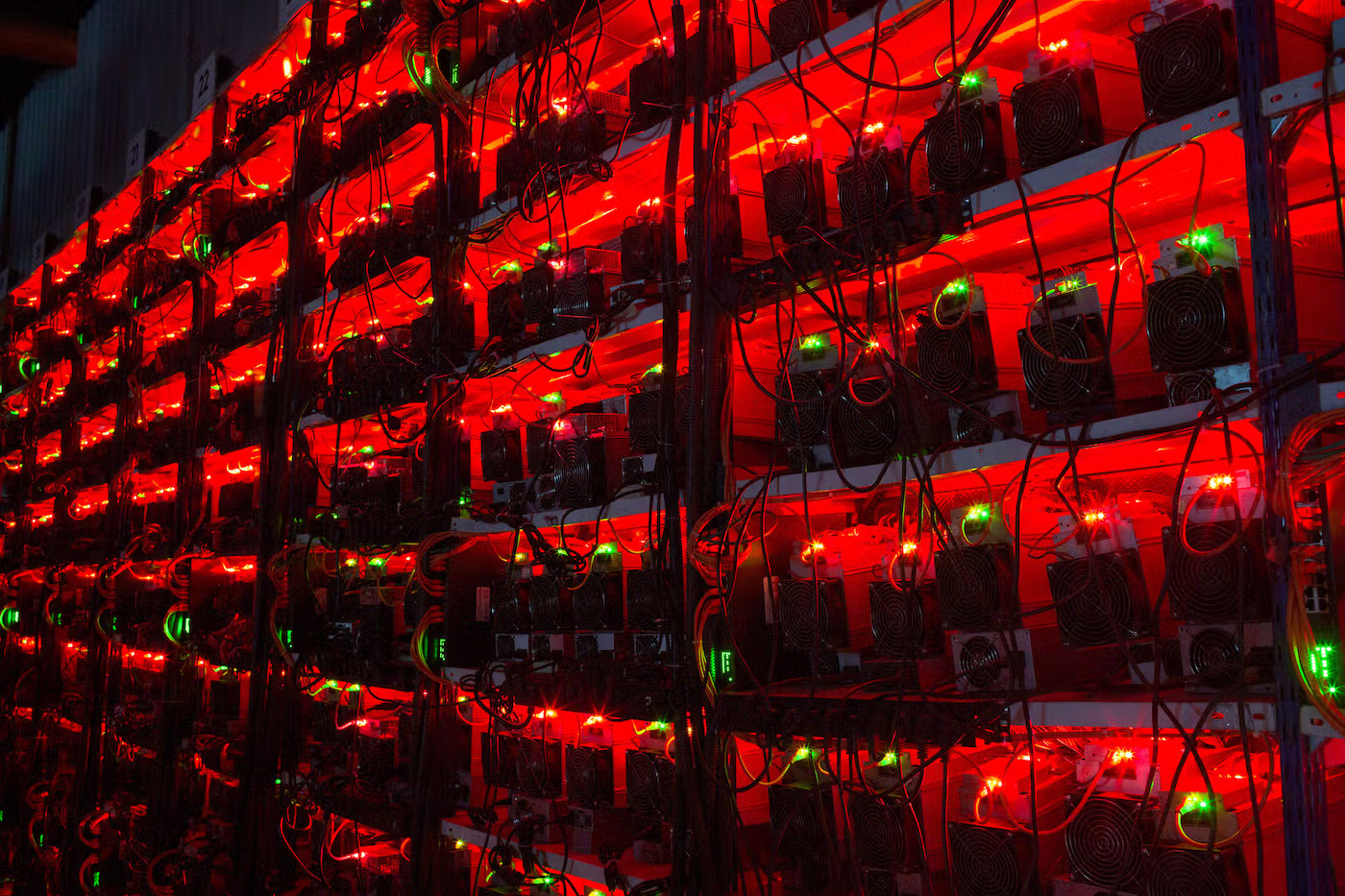
During normal operations, the primary sound-producing equipment at the Justified Data Campus will be cooling equipment, HVAC systems, and transformers.
The model assumed all identified equipment sources were operating at full load, including emergency backup generators. This is a conservative assumption: backup generators are intended to operate during a loss of grid power and otherwise for routine testing and occasional maintenance.
How the study assessed sound traveling beyond the campus
How far data center noise travels depends on the equipment and the conditions between the source and the listener. Distance is one factor; buildings, barriers, the ground, and atmospheric conditions also influence sound at nearby locations.
ERM’s modeling accounted for these factors, including shielding and reflections from structures. Evaluating sound at specific residential locations provides a more useful picture for neighbors than describing equipment noise only at its source.
How low-frequency sound was evaluated
At the community’s request, ERM also evaluated low-frequency sound, including the deeper humming or rumbling associated with large mechanical equipment in heavy industrial facilities.
The study modeled maximum levels of 67 dBC or less at every residential location evaluated, below the 70 dBC level recommended by the American National Standards Institute (ANSI). Unlike the dBA scale, which emphasizes frequencies heard most easily by the human ear, the dBC scale captures more low-frequency sound. The two measures describe sound differently and should not be compared directly.
Keeping the Hancock County community informed
The noise assessment is part of TeraWulf’s commitment to keeping the Hancock County community informed as the Justified Data Campus advances. TeraWulf’s Energy Plan also commits to ongoing public engagement and transparent responses to community questions, including noise and other environmental considerations.
For residents near the Justified Data Campus, projected sound levels are comparable to everyday background sounds in a quiet suburban setting and are not expected to noticeably increase overall noise in the surrounding communities. At the two Hawesville residential locations evaluated, modeled sound levels fall below the EPA-based reference used in the assessment, even under conservative operating assumptions that include emergency backup generators running at full load. The study also found low-frequency sound levels below the ANSI-recommended level.